
Searching Washington County Criminal Dockets
The free Colorado Judicial Branch Docket Search is the first stop. Use it for a Washington County criminal court date. Pick the 13th Judicial District, Washington County, and a date range. A date alone is not enough. Layer on the county, court type, party, attorney, or case number. A known number splits into four-digit year, class, and sequence. CR marks a District Court felony. M marks a County Court misdemeanor, and T a state traffic matter. What comes back is a hearing list, not the full criminal file.
- Choose Washington County and a useful date range in the official docket tool.
- Add a name or enter year, case class, and sequence without extra spaces.
- Match the case number, court type, location, and displayed party before relying on a row.
- Read the hearing date, time, duration, hearing type, courtroom, and appearance type.
- Call the Washington Combined Court clerk for charges, filings, disposition, or a certified copy.
When the online search comes up empty, the clerk offers a phone, counter, mail, and approved email route. Washington Combined Court sits at 26861 Highway 34, P.O. Box 455, Akron, CO 80720, and answers at 970-345-2756. A mailed request should spell out the court, number, party, the exact record, and the copy type you want. The published email, WashingtonClerksOffice@judicial.state.co.us, exists expressly for self-represented filings. Ask staff before treating that address as a copy-order channel. Older files may need a State Archives referral.
Washington County Criminal Docket Codes
Case numbers in Colorado help route a docket search. Read 2026CR4 as a District Court criminal track. Read 2026M18 as a Washington County Court misdemeanor. Public settings also list T traffic cases and some R cases. One fixed meaning for every R entry is not settled, so the clerk should confirm that class. A locality name is not a class code.
- CR
- District Court criminal class, commonly used for felony matters.
- M
- County Court misdemeanor class.
- T
- County Court state traffic class.
- Register of actions
- The dated case history of filings, orders, settings, and results.
The official Washington results interface can be seen through the Washington County filtered docket.
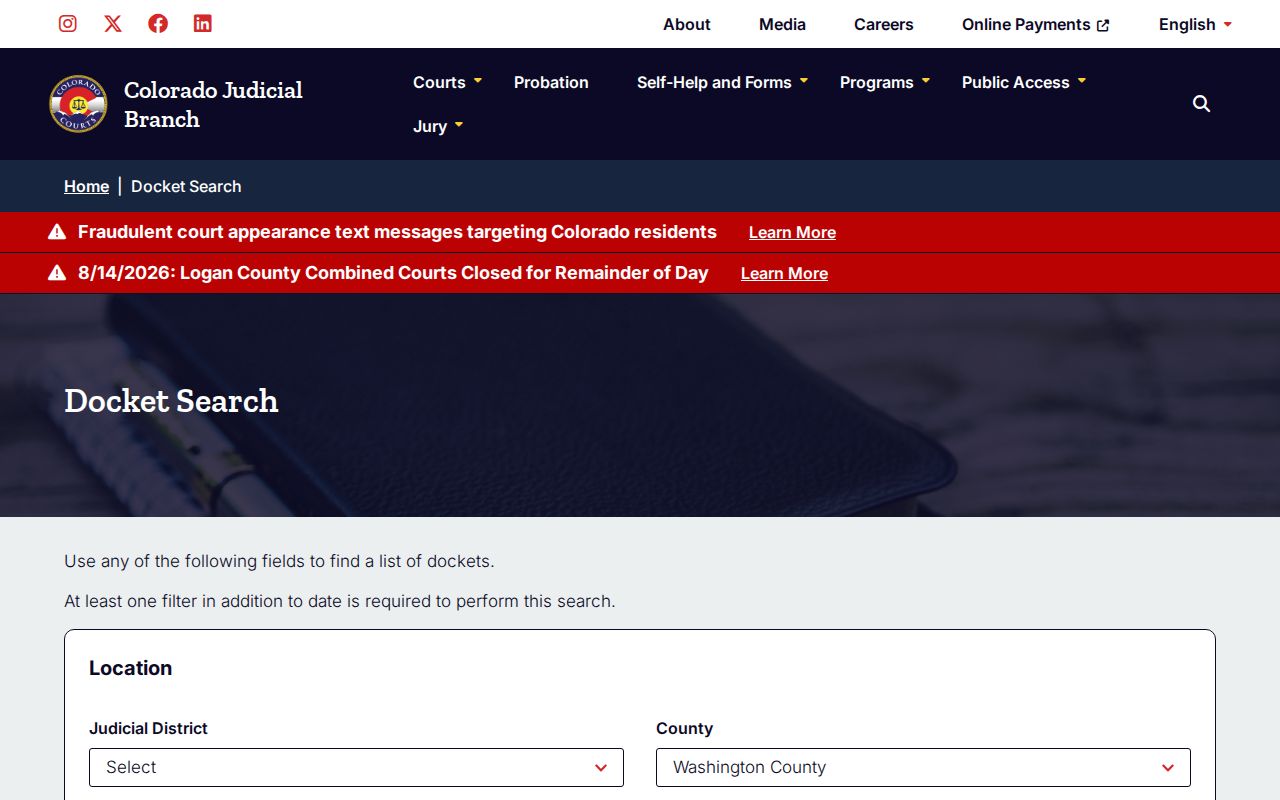
The interface shows how the date-and-filter rule works. Its rows still show settings, not a charge-by-charge criminal history.
Inside a Washington County Criminal Docket
A free calendar row carries enough data to identify and attend a setting. It does not show every detail. Charging counts, plea entries, motions, signed orders, sentences, and financial lines are not exposed. Those details live in the register of actions and filed documents. That office is the Clerk of Court, Washington Combined Court. Ask for the register when you want to trace the whole case. Ask for a named judgment, sentence, information, or order when the actual document matters.
| Case number | Year, class, and sequence, such as 2026CR4. |
|---|---|
| Public setting | Date, time, duration, hearing type, location, appearance type, and courtroom. |
| Charges and plea | Expected in the accessible register or charging records, not promised in the free calendar. |
| Case activity | Complaints, motions, responses, minute orders, resets, and other dated events. |
| Disposition | The way a charge or case ended; certified proof requires the clerk's authenticated copy. |
One event can produce several displayed rows when several parties are listed. Count unique case numbers, not names, when comparing results. A hearing label only describes a scheduled stage. It does not prove the court made the finding the label suggests.
Washington County Criminal Docket Rhythm
Washington County runs two very different schedule patterns. Ordinary County Court traffic and misdemeanor matters land on the third Thursday of each month. Those hearings start at 8:30 a.m. In-custody advisement and bond hearings happen on weekdays at 2:15 p.m. Weekend bond hearings use a separate district livestream link. So a jailed person's first appearance should never be inferred from the monthly misdemeanor setting.
Treat the published times as starting points. Closures, case-specific orders, resets, and virtual permission can move an event. The court says Washington appearances are in person. Permission for a virtual appearance must be granted. Even with permission, the participant must contact the clerk. The clerk confirms the courtroom or access link. A blank appearance-type field grants nothing remote.
For the statewide public-access policy behind these criminal records, the CJD 05-01 access page is the official source. It governs these criminal records statewide.
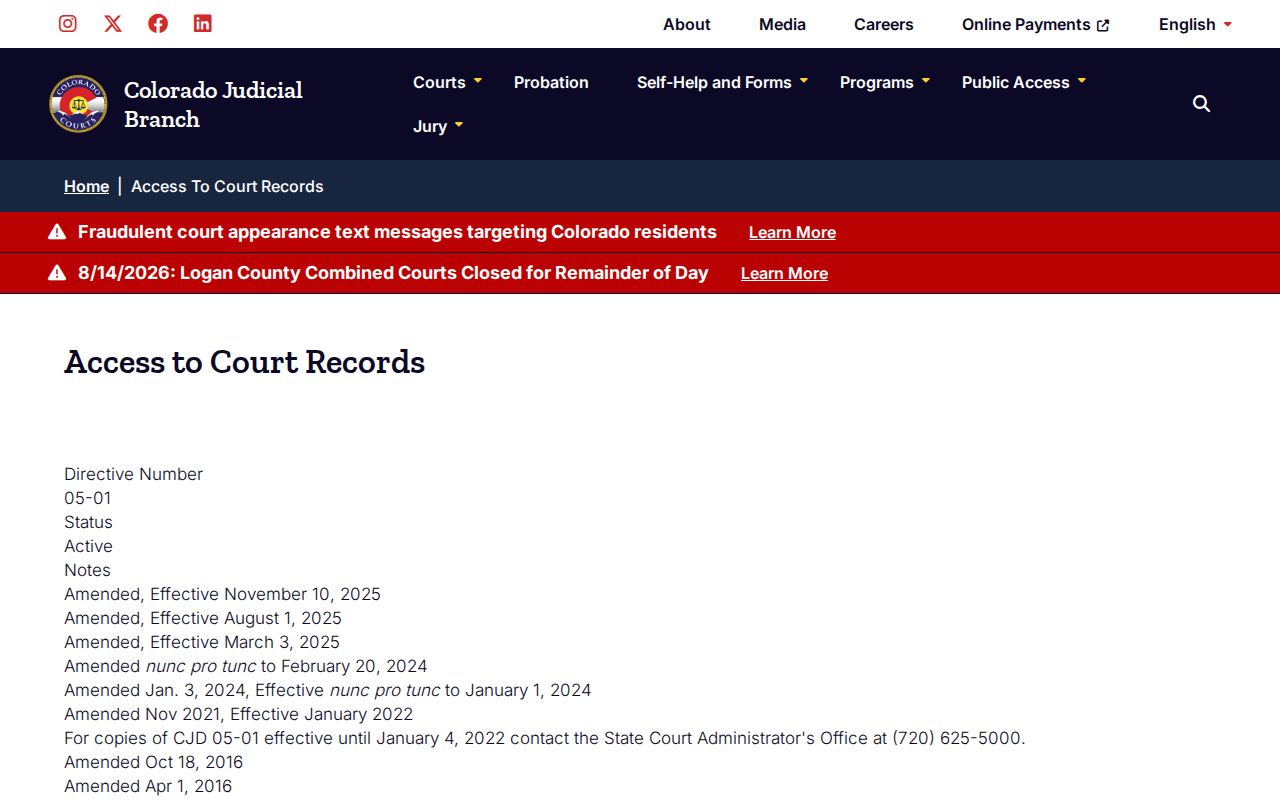
The directive separates public, restricted, remote, and courthouse access. That split explains why an event may be visible while a related document is not.
How a Criminal Case Moves
No Washington County criminal case follows one identical route in every charge. The docket often opens with a complaint or information. An advisement comes next, though. The court then records a plea or schedules the next plea stage. Pretrial conferences, status checks, motions hearings, and trial settings may follow. A negotiated plea, dismissal, or trial finding moves the case toward disposition. A conviction can then bring sentencing, restitution, and probation. Later enforcement or review entries may follow.
Docket flow: Filing › Advisement › Pretrial › Plea or Trial › Disposition › Sentencing
Public Washington results have included pretrial conferences and status conferences. Sentencing, revocation, restitution, motions, and disposition hearings appear too. A revocation hearing is not a revocation finding. It is the event where an alleged probation breach gets considered. A sentencing setting, likewise, does not show the sentence itself. The signed order and the full register control the case result.
Washington County Criminal Charge Gap
A charge missing from the Washington County criminal docket calendar is normal, because Colorado's free public tool tracks hearings rather than charges. Start simple. Confirm the case number. Widen the date range. Then make sure you picked District Court or County Court correctly. If the hearing shows but the accusation does not, ask the Combined Court for the register of actions plus the complaint or information, and name the exact filed item you need.
Two nearby channels will not fill the gap. Colorado Courts E-Filing is not an open criminal-record portal; it exists mainly for attorney filings, and its public instructions for non-attorneys center on a party's own domestic-relations or eviction case. For a criminal file, rely on the clerk. The elected Washington County Clerk and Recorder is not the custodian either, since that office runs county functions apart from state trial-court case records.
Older matters may sit locally or have moved to Colorado State Archives, so ask which. If the case could be sealed, juvenile, or restricted, give the clerk the case number and your relationship to it. A blank remote search proves nothing.
Courts That Hold Criminal Dockets
Two courts, one clerk. Washington County District Court and Washington County Court share the Combined Court clerk. Yet their criminal dockets split along case-type lines. District Court takes the felony CR matters. County Court keeps the M misdemeanors plus T state traffic cases. Akron Municipal Court stands apart. It holds Akron ordinance cases and municipal tickets on its own docket. Check the court name printed on your citation or charging papers before you search. That name tells you which clerk to call. A municipal ticket will not show up in the Washington County state docket search at all.
| Court | Typical criminal track | Record channel |
|---|---|---|
| Washington District Court | CR felony cases | State docket plus Combined Court clerk |
| Washington County Court | M misdemeanors and T traffic | State docket plus Combined Court clerk |
| Akron Municipal Court | Akron ordinances and municipal citations | Municipal clerk at 970-345-2624 |
District judges rotate across a seven-county judicial district, so local criminal assignments shift among divisions. Colorado's official judicial-officer selection information explains the statewide process. But it cannot tell you who sits on a given Washington event. Trust the judge, division, and courtroom fields on the docket row instead. That beats assuming one district judge owns each Washington case. County Judge Kelly S. Hansen handles the County Court layer. Even so, a current docket row remains the better source for any particular setting.
Washington County Criminal Hearing Labels
Hearing labels signal the stage, but each one deserves a narrow read. An advisement covers rights, custody, and early steps. A pretrial conference deals with readiness, negotiation, and scheduling. A motions hearing takes up written requests. A restitution hearing settles qualifying loss and payment terms. A disposition hearing records or decides a result at that stage, nothing more.
A Washington County criminal docket row may also list a courtroom number, lettered division, duration, and appearance type. Rotating district assignments make those fields worth checking, all of them. A short duration does not make an event optional. A blank remote field does not erase the in-person default. The Colorado jury service guidance adds state context on jury obligations.
That official guidance draws one clean line. Jury administration and criminal case entries are court functions, while the county's elected clerk runs a separate office.
Washington County Criminal Record Channels
Match the channel to the task. Docket Search is free and anonymous for scheduled events. The Combined Court counter handles inspection and copies. A phone call can confirm custody, access, cost, and the current setting. Mail a precise written request to P.O. Box 455, and ask before sending a copy order to the filing email. Commercial vendors named by the Judicial Branch may offer a full real-time register, though the Branch says documents must come from the filing court.
The public defender's 13th District office, at 970-522-5032, is a separate stop for completed defense applications. It does not certify the court record. A hearing-row printout is not a certified disposition either. Find the final judgment or sentence, then ask the clerk for a current certification and a fee quote.
Best fallback: When the public calendar gives only a setting, call 970-345-2756 with the court, case number, party name, and exact document title.
Sealed Dockets and Public Access
Chief Justice Directive 05-01 governs most Colorado court case access. It draws a line between remote access and access at a court facility. A record can be public in part without every page being downloadable. Excluded or redacted material may include personal data. It may also cover protected addresses, juvenile information, mental-health records, and sealed content. Juvenile records face specific limits under C.R.S. section 19-1-304. Criminal sealing procedures live in C.R.S. sections 24-72-701 and following.
Key Rules:
Chief Justice Directive 05-01 governs public, restricted, remote, and courthouse access to Colorado court case records.
Colorado Title 13 addresses court structure and clerk custody within the state court system.
Colorado Title 24 contains criminal-record sealing law and the Colorado Open Records Act.
CORA is not the first rule for a filed criminal pleading. Judicial administrative records follow their own rule. Case records run through the clerk and CJD 05-01. Ask what identification, authority, motion, or order a restricted file requires. A failed search is never proof of innocence, guilt, dismissal, or erasure.