
Searching Washington County Civil Dockets
Colorado's statewide portal is the first stop. Open the Colorado Judicial Branch Docket Search and choose the 13th Judicial District, Washington County, and a date range. Date alone is not enough. The form demands one more filter, whether that is a case number, a party, a business, an attorney, a court type, or a courthouse field. Searching an entity? Use the Business option, because typing a company name into individual-name fields can split the results and hide the best match.
- Read the initiating paper and identify District Court or County Court.
- Choose Washington County, a date span, and the correct court type in Docket Search.
- Enter year, class, and sequence, or select Individual or Business and enter a party name.
- Compare unique case numbers, hearing types, locations, courtrooms, and appearance fields.
- Contact the Combined Court clerk for the register, pleading, order, judgment, or certified copy.
The online result prints or exports cleanly, but it is only a settings list. Nothing appearing? Widen the date range and recheck the class. Then call 970-345-2756. The Washington Combined Court counter is at 26861 Highway 34, Akron. Mailed requests go to P.O. Box 455, Akron, CO 80720. Whatever the route, a written request should state the court, case number, party, document title or date, plain or certified status, delivery choice, and a cost limit. Ask before using the published pro se filing email for copy orders.
Washington County Civil Docket Classes
The letters inside a Washington County civil case number work like a routing code. Each prefix tells you which track the case runs on. CV marks general civil matters. DR covers domestic relations. County Court tracks use C for limited civil cases and related county matters, while small claims and forcible entry and detainer, often shortened to FED, run on their own tracks. Probate, juvenile, mental-health, and some protective matters may carry their own prefixes and distinct access limits, so a case number can hint at what you will and will not be able to see.
- CV
- District Court civil class, shown as year, CV, and sequence.
- DR
- District Court domestic-relations class.
- C
- County Court civil class used for several limited civil tracks.
- FED
- Forcible entry and detainer, the Colorado summary possession case track.
- Return date
- A summons-linked response or appearance date, not an automatic trial or judgment date.
A number like 2025DR7 goes down the District Court path. 2026C10 or a 30000-series C number lands in County Court instead. Dollar limits are statutory and can change, so check official Colorado Title 13 or ask the clerk rather than relying on an old threshold to pick jurisdiction.
Inside a Washington County Civil Docket
The free calendar is the settings slice of a civil court record. One row can carry plenty: date, time, duration, displayed party, case number, hearing type, Washington location, appearance type, and courtroom. The register of actions is broader. It normally logs filing dates, parties and counsel, the complaint or petition, service events, responses, motions, orders, settings, resets, judgment, costs, and post-judgment activity. Think of the docket as the schedule. Think of the register as the file.
| Case number | Year, civil class, and sequence, such as 2026CV12. |
|---|---|
| Parties | Plaintiff and defendant, or petitioner and respondent, subject to access rules. |
| Filings | Complaint or petition, response, exhibits, and other accepted documents. |
| Motions and orders | Requests made to the judge and the court's signed rulings. |
| Disposition | Judgment, default judgment, dismissal, settlement order, or result after hearing. |
One event with several displayed parties can create several calendar rows. Those totals are not case counts. Count the unique case number once. A return date or motions hearing says nothing about the outcome either, so order the register or the signed ruling before drawing any conclusion about the case.
Washington County Civil Calendar Traps
Washington County civil return dates are often set on Wednesdays at 1:30 p.m. That is just a local pattern. It does not turn every Wednesday entry into a trial. A return date follows a summons. It may concern a response or the next procedural step. For FED matters, the official court page tells people to contact the court directly. So confirm any FED setting that way rather than inferring it from the Wednesday schedule.
One civil event can list more than one party row. Count the case number once. A motions hearing means a request is set for consideration. It does not mean the request was granted. A temporary or permanent restraining-order hearing label marks a stage. Protected material may be involved. The calendar can reveal the event. The underlying filing stays restricted under Colorado access policy.
Rely on the latest court date. Compare it against any served notice or signed order. The focused Washington County Court Dates resource walks through the event fields and reset checks in greater detail.
Civil Case Types on the Docket
Washington County civil work spans both trial-court levels. District Court takes major civil CV matters, DR family cases, probate, juvenile, mental-health, and protective proceedings. County Court handles limited civil cases, small claims, FED matters, name changes, protection orders, and other statutory tracks. What has appeared on the public calendar? Return dates, show-cause hearings, name-change hearings, restraining-order hearings, and motions hearings.
- District civil claims filed under a CV case number.
- Domestic-relations proceedings filed under a DR case number.
- County civil claims and related C-class proceedings.
- Small-claims and FED cases handled by County Court.
- Probate, name-change, and protection-related matters, subject to access limits.
The track matters. It drives the search filter, the clerk request, and whether remote documents are available. Dollar limits are statutory and can change. A current rule or a clerk answer settles whether a new filing belongs in County or District Court. For a case already filed, the papers and the case number are the better guides.
Washington County Civil CCE Access
Colorado Courts E-Filing for non-attorneys is one way for a party to reach an eligible domestic-relations or eviction case online. Registration comes first. From there, pick "E-File into Existing Case," opt in, and wait while the court accepts the account. Approval can take up to two business days. Once the court says yes, that party can view the eligible case around the clock. Remember what this is, though: account-based access for the party. It is not an anonymous Washington County civil docket anyone can browse.
CCE pricing effective September 2025 makes searching free. Case history costs $15 for a user who did not file into the case. That access lasts 14 days. Documents are free once access is purchased. The non-attorney terms are narrower than the attorney system in several ways. A rejected filing carries no e-filing charge, though a service cost may be nonrefundable. Read the current CCE terms before paying anything.
For fee relief, the official civil fee-waiver page explains what the courts offer and how to ask for it.
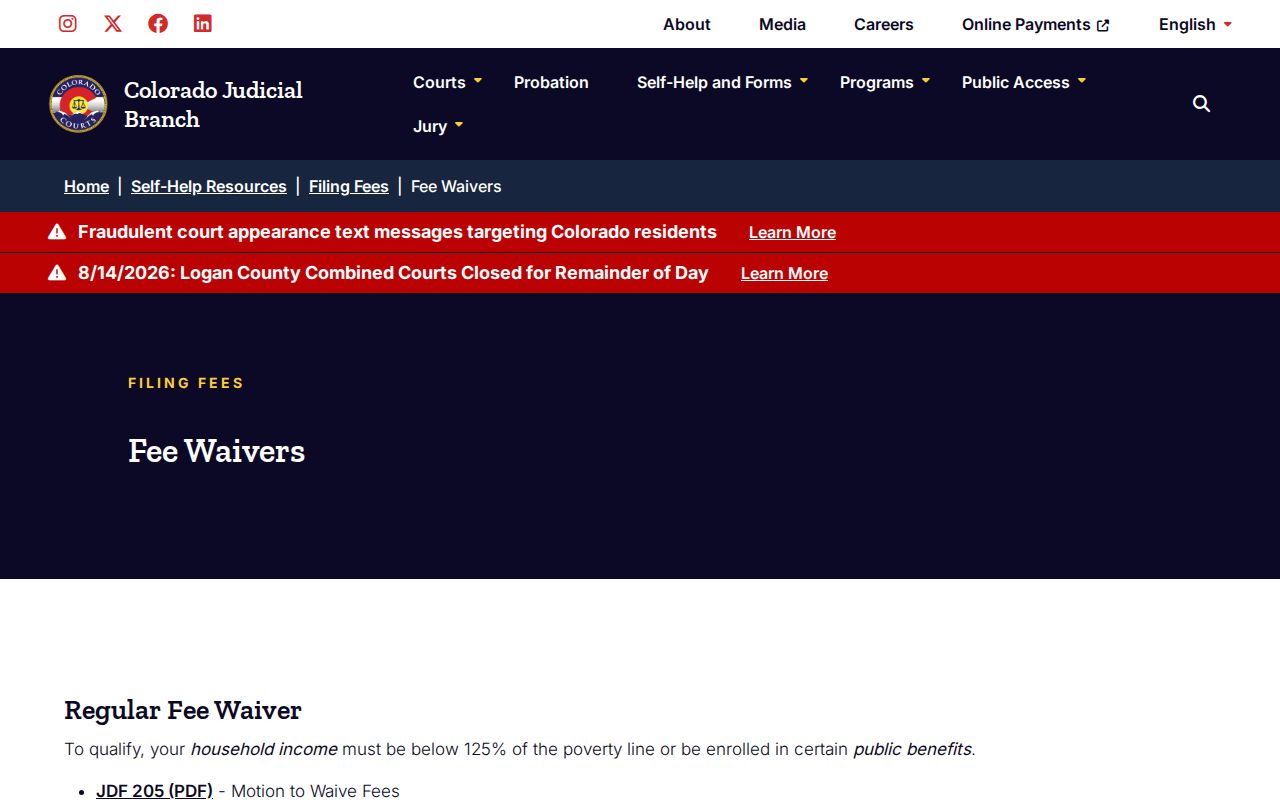
JDF 205 and JDF 206 deal with qualifying court fees after a judge reviews the request. They do not create an automatic right to free public copies of Washington County civil records.
Civil Docket Settings and Hearings
Read a Washington civil setting field by field. Check the date, start time, allotted duration, case number, hearing type, location, appearance type, and courtroom. Appearances happen in person unless the court grants virtual permission. Even with permission, confirm the courtroom or link with the clerk. A blank appearance field grants nothing.
A continuance shifts a hearing to a new date. It does not erase the old setting from a complete register. The public calendar will not show every reset. Nor will it show the motion and order behind each move. Plan around the newest future event, then compare it with the signed order. Call 970-345-2756 close to the hearing if weather, closure notices, a recent filing, or travel makes timing critical.
The 13th District's expedited civil proceedings order spells out local civil docket practice. District civil dockets rotate across divisions. For one Washington County case, the displayed division and courtroom beat any general judge list. Never assume a single resident district judge holds every local civil case.
Washington County Civil Filing Help
Self-represented civil filers in Washington County have two local support routes. Neither one is legal advice. Pro se filings are accepted at WashingtonClerksOffice@judicial.state.co.us. If a filing needs payment, the filer must contact the court. Treat that email as a filing channel only. It is not a guaranteed records-request portal. A sent paper is not proof of acceptance.
The statewide Colorado self-help portal works alongside the 13th District Self-Represented Litigant Coordinator. The coordinator offers noncriminal forms and process help at 970-542-5252 and 13selfhelp@judicial.state.co.us. The coordinator staffs Washington service at Combined Court on the first Wednesday of each month, 8:30 a.m. to 4:00 p.m. Walk-ins and appointments both work. That help has limits. The coordinator cannot certify a record or choose your claim for you.
Payment-bearing filing: Contact Washington Combined Court before sending the document so staff can explain the current payment and submission steps.
Washington County Civil Record Channels
Each channel serves a different purpose. Docket Search finds scheduled events at no cost. CCE gives account access to a party's eligible own DR or eviction case. The clerk counter handles inspection and copy questions, while a phone call can confirm location, custody, public status, price, and delivery. Mail works best for a precise written order. Email takes pro se filings, though record-copy use must be confirmed, and the State Archives may hold older files that were transferred.
| Need | Best first channel | Limit |
|---|---|---|
| Next hearing | Official Docket Search | Shows settings, not the full file |
| Own eligible DR or eviction case | CCE registration and opt-in | Party access and approval rules apply |
| Register or filed order | Combined Court clerk | Access, retrieval, and copy fees may apply |
| Older record | Clerk, then State Archives | May require collection or volume details |
The Judicial Branch also notes that full real-time registers may be searched through named commercial vendors. Copies still come from the filing court. Washington posts no fixed local copy price or turnaround time, so ask for a quote before mailing any payment.
Civil Docket Access Rules
Chief Justice Directive 05-01 is Colorado's main policy for court case records. It separates public access from remote access. A public civil case can still hold protected data. Some documents may be viewable only at a court facility. Juvenile, adoption, mental-health, protected-address, and some protection-related material may be restricted or redacted. A seal or court order can limit access in a specific case too. That split matters.
Access route: Chief Justice Directive 05-01 governs Colorado court case records and correction requests.
Chief Justice Directive 06-01 controls case-file retrieval, research, redaction, scanning, and copy-cost assessment.
Colorado Revised Statutes provide current Title 13 court rules and Title 24 public-record provisions.
The Colorado Open Records Act does not override the judiciary's rules for a filed civil pleading. PAIRR Rule 2 covers Judicial Branch administrative records. It expressly excludes court records. So route a request for a complaint, judgment, or register to the Clerk of Court. Administrative requests are different. Budgets or policy correspondence go to the proper Judicial Branch records custodian.